
Section :
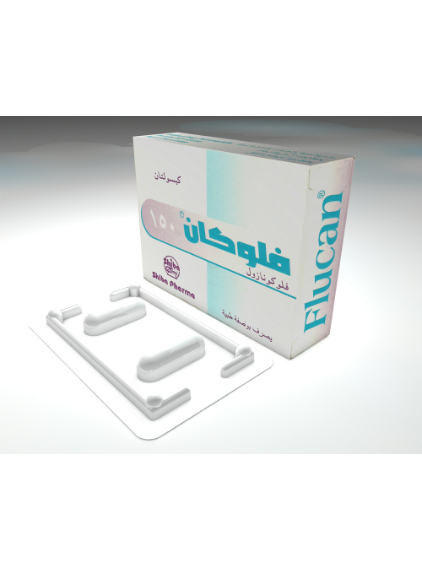
Flucan
📌 COMPOSITION
Each capsule contains: Fluconazole 150 mg, 200 mg.
📌 DESCRIPTION
Flucan (Fluconazole) is an antimycotic compound belonging to a new class of triazole agents. It is a powerful specific inhibitor of the synthesis of fungal steroids. Flucan activity has been proved against opportunistic mycotic infections such as those caused by Candida spp., Cryptococcus neoformans, Microsporum spp. and Trichophyton spp. After oral administration it is well absorbed, showing systemic bioavailability up to 90% with respect to its level reached after intravenous administration. Peak plasma concentration under fasted conditions are reached after a period between 30 to 90 minutes. About 80% of the dose is excreted unchanged in urine.
📌 INDICATIONS
- Vaginal candidiasis, oropharyngitis, oesophagitis caused by candida.
- Fungal infections of the skin and nails due to candida or dermatophytes.
- Serious systemic candidal infections including genitourinary, gastrointestinal infections, peritonitis and pneumonia.
- Cryptococcal meningitis.
- For the prophylaxis of fungal infections in immunocompromised patients.
📌 DOSAGE AND ADMINISTRATION
- Vaginal candidiasis: One capsule (150 mg) as a single oral dose is given.
- Cutaneous fungal infections: One capsule (150 mg) as a single oral dose is given. This dose is repeated after one week. In rare cases, a dose can be given on the third and the fourth week.
- Oropharyngeal and oesophageal candidiasis: A daily dose of one capsule (150 mg) is given.
- Serious systemic candidiasis and Cryptococcal meningitis: Start with a loading dose of 2-3 capsules (300-450 mg) then a daily dose of 1-2 capsules (150-300 mg) and treatment is continued according to case response.
- In patients with impaired renal functions:
- Full dosage, if plasma creatinine clearance exceeds 0.8 ml/sec is recommended.
- Half dosage if plasma creatinine clearance is 0.35 - 0.8 ml/sec is recommended.
- One quarter dosage, if plasma creatinine clearance is 0.18 - 0.35 ml/sec is recommended.
📌 RESTRICTIONS ON USE
Contraindications
It is contraindicated in patients who have shown hypersensitivity to Fluconazole or triazole compounds or in case of acute impaired liver function.
Precautions
In patients who develop skin rash or liver function abnormalities, treatment should be discontinued.
Use in Pregnancy and Lactation
Fluconazole is contraindicated during pregnancy and lactation.
📌 DRUG INTERACTIONS
- Fluconazole shows interaction with the following drugs: warfarin, tolbutamide, sulphonylureas, hydrochlorothiazide, phenytoin, rifampicin and theophylline. When the concomitant administration of one of the drugs mentioned above and Fluconazole is necessary, it is sufficient to monitor the hematic levels of the respective drug and adjust the doses to the therapeutic requirement level.
- In particular in the case of simultaneous administration of Fluconazole with tolbutamide, the dosage of the hypoglycemic drug and the level of blood sugar are necessary to be monitored.
- In case of concomitant administration of Fluconazole with cyclosporin, monitoring of the plasma concentrations of cyclosporin is advised.
📌 SIDE EFFECTS
Fluconazole is very well tolerated. The commonest effects: nausea, vomiting, diarrhea, abdominal pain. Skin rash, headache, dizziness may occur; also abnormalities of liver enzymes have been reported. In rare cases as with other azoles group, anaphylactic reaction may occur.
📌 STORAGE INSTRUCTIONS
Store below 30°C in a dry place.
📌 PRESENTATIONS
Flucan 150, 200 capsules: Pack of 2 capsules and hospital packs of different sizes.